cobre-stochastic
alpha
cobre-stochastic provides the stochastic process models for the Cobre power
systems ecosystem. It builds probabilistic representations of hydro inflow
time series — using Periodic Autoregressive (PAR(p)) models — and generates
correlated noise scenarios for use by iterative scenario-based optimization
algorithms. The crate is solver-agnostic: it supplies fully-initialized
stochastic infrastructure components that any scenario-based iterative
optimization algorithm can consume read-only, with no dependency on any
particular solver vertical.
The crate has no dependency on cobre-solver or cobre-comm. It depends only
on cobre-core for entity types and on a small set of RNG and hashing crates
for deterministic noise generation.
Module overview
| Module | Purpose |
|---|---|
par | PAR(p) coefficient preprocessing: validation, original-unit conversion, and the PrecomputedPar cache |
par::evaluate | PAR model forward evaluation (evaluate_par) and inverse noise solving (solve_par_noise) |
par::fitting | PAR model estimation: Levinson-Durbin recursion, seasonal statistics, AR coefficient and correlation estimation, PACF/AIC order selection |
noise | Deterministic noise generation: SipHash-1-3 seed derivation (seed) and Pcg64 RNG construction (rng) |
noise::quantile | Beasley-Springer-Moro inverse normal CDF (norm_quantile) |
normal | Normal noise precomputation for load demand modeling: PrecomputedNormal cache with stage-major layout |
correlation | Spectral spatial correlation: eigendecomposition (spectral) and profile resolution (resolve) |
tree | Opening scenario tree: flat storage structure (opening_tree) and tree generation (generate) |
tree::lhs | Latin Hypercube Sampling: batch generate_lhs and point-wise sample_lhs_point |
tree::qmc_sobol | Sobol QMC sequence generation with Joe-Kuo direction tables and Matousek scrambling |
tree::qmc_halton | Halton QMC sequence generation with Owen-style digit scrambling and prime sieve |
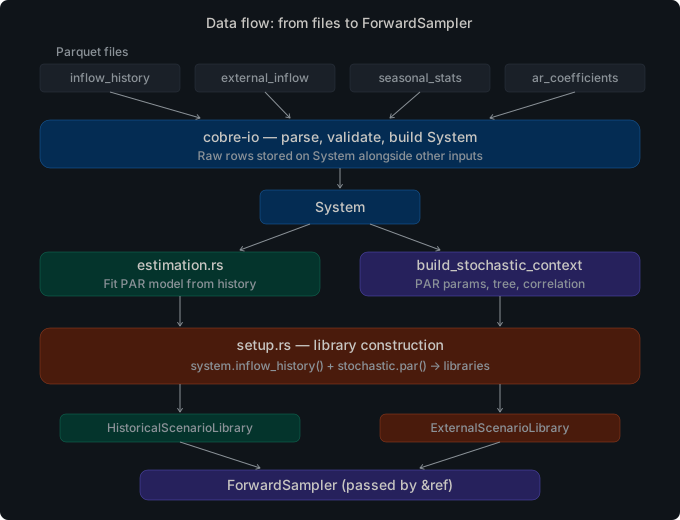
sampling | Forward-pass sampling abstraction: ForwardSampler struct (composite sampler), ClassSampler enum, build_forward_sampler factory, SampleRequest and ForwardNoise types; insample sub-module for tree-based selection |
sampling::out_of_sample | Out-of-sample fresh noise generation dispatching over NoiseMethod |
sampling::historical | Historical inflow replay: HistoricalScenarioLibrary construction, window discovery, eta standardization, lag seeding, and forward-pass window selection |
sampling::external | External scenario sources: ExternalScenarioLibrary construction, per-class standardization (PAR inversion for inflow, mean/std for load and NCS), and forward-pass scenario lookup |
sampling::class_sampler | Per-class noise source enum (ClassSampler): InSample tree segment copy, OutOfSample fresh noise, Historical window replay, and External library lookup |
sampling::window | Historical window discovery: discover_historical_windows finds contiguous year spans covering the study period in inflow_history.parquet |
context | StochasticContext integration type and build_stochastic_context pipeline entry point |
error | StochasticError with nine variants covering six failure domains of the stochastic layer |
Architecture
PAR(p) preprocessing and flat array layout
PAR(p) (Periodic Autoregressive) models describe the seasonal autocorrelation
structure of hydro inflow time series. Each hydro plant at each stage has an
InflowModel with a mean (mean_m3s), a standard deviation (std_m3s), and
a vector of AR coefficients in standardized form (ar_coefficients).
PrecomputedPar is built once at initialization from raw InflowModel
parameters. It converts AR coefficients from standardized form (ψ*,
direct Yule-Walker output) to original-unit form at build time:
ψ_{m,ℓ} = ψ*_{m,ℓ} · s_m / s_{m-ℓ}
where s_m is std_m3s for the current stage’s season and s_{m-ℓ} is
std_m3s for the season ℓ stages prior. The converted coefficients and their
derived intercepts (base) are stored in stage-major flat arrays:
array[stage * n_hydros + hydro]          (2-D: means, stds, base terms)
psi[stage * n_hydros * max_order + hydro * max_order + lag]  (3-D: AR coefficients)
This layout ensures that all per-stage data for every hydro plant is contiguous in memory, maximizing cache utilization during sequential stage iteration within a scenario trajectory.
All hot-path arrays use Box<[f64]> (via Vec::into_boxed_slice()) rather
than Vec<f64>. The boxed-slice type communicates the no-resize invariant and
eliminates the capacity word from each allocation.
Deterministic noise via communication-free seed derivation
Each scenario realization in an iterative optimization run requires a draw from the noise distribution. Rather than broadcasting seeds across compute nodes — which would require communication and create a serialization point as the number of ranks grows — each node independently derives its own seed from a small tuple using SipHash-1-3.
Two derivation functions are provided:
derive_forward_seed(base_seed, iteration, scenario, stage) -> u64: hashes a 20-byte little-endian wire formatbase_seed (8B) ++ iteration (4B) ++ scenario (4B) ++ stage (4B).derive_opening_seed(base_seed, opening_index, stage) -> u64: hashes a 16-byte wire formatbase_seed (8B) ++ opening_index (4B) ++ stage (4B).
The different wire lengths provide domain separation without explicit prefixes,
preventing hash collisions between forward-pass seeds and opening-tree seeds.
stage in both functions is always stage.id (the domain identifier), never
stage.index (the array position), because array positions shift under stage
filtering while IDs are stable.
From the derived seed, a Pcg64 RNG is constructed via rng_from_seed. The
PCG family provides good statistical quality with fast generation, suitable
for producing large numbers of standard-normal samples via the StandardNormal
distribution.
Spectral spatial correlation
Hydro inflow series at neighboring plants are spatially correlated. cobre-stochastic
applies a spectral transformation to convert independent standard-normal samples
into correlated samples.
The spectral decomposition uses a cyclic Jacobi eigendecomposition (~200 lines).
No external linear algebra crate is added to the dependency tree. The symmetric
matrix square root D = V * diag(sqrt(lambda)) * V^T (where V is the matrix
of eigenvectors and lambda are the eigenvalues) is stored in dense n x n
format. Negative eigenvalues are clipped to zero before the square root,
making the method robust to estimated correlation matrices that are not
positive-definite or are rank-deficient.
Correlation profiles can be defined per-season. DecomposedCorrelation holds
all profiles in a BTreeMap<String, Vec<GroupFactor>> — the BTreeMap
guarantees deterministic iteration order, which is required for
declaration-order invariance.
Before entering the hot optimization loop, callers must invoke
DecomposedCorrelation::resolve_positions(&mut self, entity_order: &[EntityId])
once. This pre-computes the positions of each group’s entities within the
canonical entity order and stores them on each GroupFactor as
Option<Box<[usize]>>. With positions pre-computed, apply_correlation
avoids a per-call O(n) linear scan and heap allocation on the hot path.
If a correlation group’s entity IDs are only partially present in
entity_order, the spectral transform is skipped for that group entirely.
Entities not in any group retain their independent noise values unchanged.
Opening tree structure
The opening scenario tree pre-generates all noise realizations used during the backward pass of the optimization algorithm, before the iterative loop begins. This avoids per-iteration recomputation and ensures the backward pass always operates on a fixed, reproducible set of scenarios.
OpeningTree stores all noise values in a single flat contiguous array with
stage-major ordering:
data[stage_offsets[stage] + opening_idx * dim .. + dim]
The stage_offsets array has length n_stages + 1. The sentinel entry
stage_offsets[n_stages] equals data.len(), making bounds checks exact
without special-casing the last stage. This sentinel pattern is used
consistently in PrecomputedPar, OpeningTree, and throughout
StochasticContext.
Pre-study stages (those with negative stage.id) are excluded from the
opening tree but remain in inflow_models for PAR lag initialization.
Noise generation algorithms
The opening tree and the out-of-sample forward pass both use these algorithms
to produce standard-normal noise vectors. The algorithm used at each stage is
selected by the NoiseMethod field on the stage’s ScenarioSourceConfig.
LHS (Latin Hypercube Sampling)
LHS stratifies the unit interval [0, 1) for each dimension into N
equal-probability strata [k/N, (k+1)/N) and ensures exactly one sample per
stratum, guaranteeing better marginal coverage than plain Monte Carlo.
Batch (generate_lhs): for each dimension, generate stratified samples
u[k] = (k + U_k) / N where U_k ~ U(0,1), apply a Fisher-Yates shuffle
to a permutation of 0..N, write output[perm[k] * dim + d] = norm_quantile(u[k]).
Output layout is opening-major: output[opening * dim + entity].
Point-wise (sample_lhs_point): for a single scenario within an
OutOfSample forward pass, derive per-dimension permutations identically on
all workers from (sampling_seed, iteration, stage_id) via
derive_opening_seed. Each worker independently looks up its stratum from the
shared permutation and samples a within-stratum offset from an independent
derive_forward_seed-based RNG. No inter-worker communication is required.
The N scenarios across all workers form a valid LHS design.
Both paths apply norm_quantile to convert uniform stratified samples to
standard-normal values.
Sobol (QMC)
The Sobol sequence is a low-discrepancy sequence that fills the d-dimensional
unit hypercube more uniformly than pseudo-random samples, reducing the
effective variance of Monte Carlo estimates.
Direction numbers: dimension 1 uses the van der Corput sequence. Dimensions
2–21,201 use the Joe-Kuo 2010 direction number dataset (21,200 entries) stored
as a static Rust array — no runtime allocation or deserialization. The maximum
supported dimension is MAX_SOBOL_DIM = 21201.
Batch (generate_qmc_sobol): builds the full 32-bit direction matrix once
per stage, then generates all n_openings points using the Gray-code
recurrence for O(1) updates per point.
Point-wise (scrambled_sobol_point): generates a single scenario’s noise
vector via direct binary decomposition of the scenario index. Used by the
out-of-sample forward pass.
Scrambling: both paths apply Matousek linear scrambling
x' = a*x + b (mod 2^32) with parameters derived from the stage seed. This
breaks the low-dimensional correlation artifacts of the plain Sobol sequence.
After scrambling, each coordinate is divided by 2^32 and transformed to
N(0,1) via norm_quantile.
Halton (QMC)
The Halton sequence assigns each dimension a distinct prime base. Dimension
d (1-indexed) uses the d-th prime: 2, 3, 5, 7, 11, … The coordinate of
point n in dimension d is radical_inverse(n, p_d) — the base-p_d
representation of n reflected about the decimal point.
Prime sieve (sieve_primes): computed once at generator initialization
using the sieve of Eratosthenes. There is no dimension limit.
Scrambling: the plain Halton sequence suffers from correlation artifacts in
high dimensions. Owen-style random digit scrambling applies a seed-derived
permutation pi[d][j] of size p_d to each digit position j of each
dimension d. The permutation tables are deterministic from the stage seed.
Batch (generate_qmc_halton) and point-wise (scrambled_halton_point)
follow the same structure as the Sobol variants. After scrambling and
radical_inverse, each coordinate is transformed to N(0,1) via norm_quantile.
BSM inverse normal CDF (norm_quantile)
All three noise algorithms (LHS, Sobol, Halton) use norm_quantile to convert
uniform values in (0, 1) to standard-normal values. The implementation uses
the Beasley-Springer-Moro (BSM) piecewise approximation:
- Central region (
|p - 0.5| < 0.42): rational approximation iny = p - 0.5withr = y^2. - Intermediate tails (
1e-20 < p <= 0.08or0.92 <= p < 1 - 1e-20): degree-8 polynomial inr = ln(-ln(min(p, 1-p))). - Extreme tails (
p <= 1e-20): clamped to ±8.21.
Absolute error is better than 3e-9 over the entire open interval (0, 1). No external numerical library is required.
Forward sampler architecture
ForwardSampler<'a> is a composite struct that unifies all supported
forward-pass sampling strategies under a single sample() dispatch method.
It holds three ClassSampler<'a> instances — one per entity class (inflow,
load, NCS) — and applies per-class spectral correlation only for
OutOfSample class samplers. Use build_forward_sampler to construct the
appropriate sampler from a ForwardSamplerConfig and a StochasticContext.
ForwardSampler<'a> struct
#![allow(unused)]
fn main() {
pub struct ForwardSampler<'a> {
    inflow: ClassSampler<'a>,
    load: ClassSampler<'a>,
    ncs: ClassSampler<'a>,
    dims: ClassDimensions,
    inflow_correlation: Option<CorrelationRef<'a>>,
    load_correlation: Option<CorrelationRef<'a>>,
    ncs_correlation: Option<CorrelationRef<'a>>,
}
}
The lifetime 'a refers to the StochasticContext that owns the opening
tree, entity order, and correlation data. The sampler is constructed once and
reused across all (iteration, scenario, stage) calls without per-call
allocation.
The sample() method splits the caller-supplied noise_buf into three
segments [hydros | load_buses | ncs], delegates to each class sampler’s
fill(), then applies per-class spectral correlation where
Some(CorrelationRef) is present. Correlation is only applied to
OutOfSample class samplers; InSample, Historical, and External
samplers produce pre-correlated noise that must not be transformed again.
ClassSampler<'a> enum
ClassSampler<'a> is the per-entity-class noise source. Four variants:
InSample: copies a segment from the pre-generated opening tree. Storestree: OpeningTreeView<'a>,base_seed: u64,offset: usize, andlen: usize. Delegates tosampling::insample::sample_forward.OutOfSample: generates fresh independent N(0,1) noise on-the-fly. Storesforward_seed: u64,dim: usize, andnoise_methods: Box<[NoiseMethod]>(one per stage).Historical: replays a pre-standardized inflow window from aHistoricalScenarioLibrary. Only supported for the inflow class.External: reads from a pre-standardizedExternalScenarioLibrary. Supported for inflow, load, and NCS classes.
build_forward_sampler factory
#![allow(unused)]
fn main() {
pub fn build_forward_sampler(
    config: ForwardSamplerConfig<'_>,
) -> Result<ForwardSampler<'_>, StochasticError>
}
Constructs a ForwardSampler from a ForwardSamplerConfig struct that
bundles all construction parameters:
class_schemes— per-classSamplingSchemeselections (inflow, load, NCS). ANonescheme defaults toInSample.ctx—&StochasticContextproviding the opening tree, seeds, correlation, and entity order.stages—&[Stage]used byOutOfSampleto read per-stage noise methods.dims—ClassDimensionswith per-class entity counts for buffer splitting.historical_library— required when inflow scheme isHistorical.external_inflow_library,external_load_library,external_ncs_library— required when the corresponding class scheme isExternal.
Returns StochasticError::MissingScenarioSource when:
OutOfSampleis requested but noforward_seedis configured inctx.Historicalis requested for the inflow class buthistorical_libraryisNone.Historicalis requested for load or NCS (only inflow is supported).Externalis requested but the corresponding library isNone.
ForwardNoise<'b> return type
#![allow(unused)]
fn main() {
pub struct ForwardNoise<'b>(pub &'b [f64]);
}
A newtype wrapping a borrowed slice of noise values. The lifetime 'b is
tied to the caller-supplied noise_buf. ForwardNoise::as_slice() returns
the underlying &[f64], allowing callers to consume the noise uniformly
regardless of which sampling variant produced it.
SampleRequest<'b> argument bundle
#![allow(unused)]
fn main() {
pub struct SampleRequest<'b> {
    pub iteration: u32,
    pub scenario: u32,
    pub stage: u32,
    pub stage_idx: usize,
    pub noise_buf: &'b mut [f64],
    pub perm_scratch: &'b mut [usize],
    pub total_scenarios: u32,
}
}
Bundles seven per-call arguments to keep ForwardSampler::sample() within the
project’s argument-budget convention. noise_buf must be at least dims.total
elements long; perm_scratch must be at least total_scenarios elements long.
Both are caller-owned, pre-allocated working buffers — no allocation inside
sample().
FreshNoiseSpec internal bundle
FreshNoiseSpec (in sampling::out_of_sample) bundles seed, dimension, and
method parameters for fill_uncorrelated. It is pub(crate) and not part of
the public API.
OutOfSample dispatch path
When a ClassSampler::OutOfSample is active, its fill() method performs
the following steps:
- Look up
noise_methods[stage_idx]to determine theNoiseMethodfor the current stage. ReturnsStochasticError::InsufficientDataifstage_idxis out of bounds. - Build a
FreshNoiseSpecbundling the forward seed, noise method, iteration, scenario, stage ID, dim, and total scenario count. - Call
fill_uncorrelated(spec, output, perm_scratch), which dispatches onNoiseMethod: callsfill_saa(SAA),sample_lhs_point(LHS),scrambled_sobol_point(QmcSobol), orscrambled_halton_point(QmcHalton).Selectivefalls back to SAA with atracing::warn!.
After all three class buffers are filled, ForwardSampler::sample() applies
per-class spectral correlation for each class that has Some(CorrelationRef).
The correlation transform calls decomposed.apply_correlation_for_class(stage, buf, entity_order, class_name) in-place, transforming the independent N(0,1)
noise to spatially correlated noise. The final ForwardNoise wraps the full
combined buffer slice.
StochasticContext as the integration entry point
StochasticContext bundles the three independently-built components into a
single ready-to-use value:
PrecomputedPar— PAR coefficient cache for LP RHS patching.DecomposedCorrelation— pre-decomposed spectral factors for all profiles.OpeningTree— pre-generated noise realizations for the backward pass.
build_stochastic_context(&system, base_seed) runs the full preprocessing
pipeline in a fixed order: validate PAR parameters, build the coefficient
cache, decompose correlation matrices, generate the opening tree. After
construction, all fields are immutable. StochasticContext is Send + Sync,
verified by a compile-time assertion and a unit test.
sample_forward for InSample scenario selection
sample_forward implements the InSample scenario selection strategy: for each
(iteration, scenario, stage) triple, it deterministically selects one opening
from the tree by deriving a seed via derive_forward_seed and sampling a
Pcg64 RNG. The selected opening index and its noise slice are returned together,
so the caller can both log which opening was chosen and immediately use the
noise values.
PAR model evaluation
The par::evaluate module provides two complementary functions for applying a
fitted PAR(p) model to concrete state and noise values. Both operate on slices
(no allocation) and are designed for repeated calls inside the iterative
optimization loop.
evaluate_par
Computes the inflow for a single hydro plant at a single stage:
a_h = deterministic_base + Σ_{l=0}^{order-1} psi[l] * lags[l] + sigma * eta
where deterministic_base is the precomputed intercept μ_m − Σ ψ_{m,l} μ_{m−l}
(stored in PrecomputedPar), psi[l] are the AR coefficients in original
units, lags[l] are the observed inflow values at lag positions 1..p, sigma
is the residual standard deviation, and eta is the standardized noise draw.
The returned value may be negative; truncation to a physical minimum (e.g., zero) is the caller’s responsibility.
#![allow(unused)]
fn main() {
use cobre_stochastic::evaluate_par;

// AR(1): a_h = 70.0 + 0.48 * 90.0 + 28.62 * 0.5 = 127.51
let a_h = evaluate_par(70.0, &[0.48], 1, &[90.0], 28.62, 0.5);
}
The batch variant evaluate_par_batch fills an output slice for all hydro
plants at a given stage in one call, reading from a lag matrix indexed as
[lag * n_hydros + hydro] for cache-optimal access.
solve_par_noise
The inverse function: given a target inflow, solve for the noise value η that
produces it:
η = (target − deterministic_base − Σ psi[l] * lags[l]) / sigma
A common use case is computing the truncation noise floor (the η at which
the inflow would reach zero):
#![allow(unused)]
fn main() {
use cobre_stochastic::solve_par_noise;

// Solve for η such that inflow = 0.0
let eta = solve_par_noise(70.0, &[0.48], 1, &[90.0], 28.62, 0.0);
}
When sigma == 0.0 (deterministic stage), f64::NEG_INFINITY is returned to
indicate that no finite noise bound applies. The batch variant solve_par_noise_batch
fills an output slice for all hydros at a given stage.
Estimation pipeline
The par::fitting module implements the complete pipeline for fitting PAR(p)
model parameters from historical inflow observations. The pipeline consists of
four steps, each a standalone function that can be composed independently.
Step 1: Seasonal statistics
estimate_seasonal_stats groups historical observations by (entity, season)
and computes the sample mean and Bessel-corrected standard deviation (N − 1
divisor) for each group. Observations are matched to seasons via the stage
table’s start_date / end_date intervals.
Input: &[(EntityId, NaiveDate, f64)] observation triples, sorted by
(entity_id, date). Output: Vec<SeasonalStats>, sorted by
(entity_id, stage_id).
Step 2: AR coefficient estimation
estimate_ar_coefficients computes cross-seasonal autocorrelations from the
historical observations and calls levinson_durbin internally to fit an AR(p)
model of at most max_order for each (entity, season) pair.
The cross-seasonal autocorrelation for season m at lag l is:
γ_m(l) = (1 / (N_m − 1)) · Σ_{t: season(t)=m} (a_t − μ_m)(a_{t−l} − μ_{m−l})
ρ_m(l) = γ_m(l) / (s_m · s_{m−l})
where μ_m and s_m come from the seasonal statistics and season indices
wrap cyclically. Output: Vec<ArCoefficientEstimate>, each carrying the
standardized AR coefficients ψ*₁..ψ*ₚ and the residual std ratio σ_m / s_m.
Step 3: Levinson-Durbin recursion
levinson_durbin solves the Yule-Walker equations for an AR(p) process in
O(p²) time without forming the full Toeplitz matrix. Given autocorrelations
ρ(1)..ρ(p), it returns a LevinsonDurbinResult containing:
coefficients— fitted AR coefficients ψ*₁..ψ*ₚsigma2_per_order— prediction error variance at each intermediate orderparcor— partial autocorrelation (reflection) coefficientssigma2— final prediction error variance
The recursion is truncated if the prediction error variance drops to or below
f64::EPSILON, handling near-singular autocorrelation sequences without
returning an error.
Step 4: Order selection
Two order selection methods are available:
PACF-based selection (default): select_order_pacf selects the AR order
using the periodic partial autocorrelation function (PACF) with a 95%
significance threshold. The maximum significant lag becomes the AR order.
This method avoids overfitting in series with little autocorrelation and
captures meaningful persistence where it exists. PACF-based selection is the
default since v0.1.9.
AIC-based selection: select_order_aic selects the AR order that minimises
the Akaike Information Criterion:
AIC(p) = N · ln(σ²_p) + 2p
where N is the number of historical observations for the season and σ²_p
is the prediction error variance from LevinsonDurbinResult::sigma2_per_order.
The white-noise baseline (order 0) has AIC(0) = 0.0. On ties the lower
order wins (parsimony principle).
Step 5: Correlation estimation
estimate_correlation computes the Pearson correlation matrix of PAR model
residuals across entities. Residuals are the standardized deviations of
historical observations from their seasonal means. The output is a
CorrelationModel (from cobre-core) suitable for downstream spectral
decomposition.
Public types
StochasticContext
Owns all three preprocessing pipeline outputs: PrecomputedPar,
DecomposedCorrelation, and OpeningTree. Constructed by
build_stochastic_context and then consumed read-only. Accessors:
par(), correlation(), opening_tree(), tree_view(), base_seed(),
dim(), n_stages(). Both Send and Sync.
PrecomputedPar
Cache-friendly PAR(p) model data for LP RHS patching. Stores means, standard
deviations, original-unit AR coefficients (ψ), and intercept terms (base) in
stage-major flat arrays (Box<[f64]>). Built via PrecomputedPar::build.
Accessors: n_hydros(), n_stages(), max_order(), mean(), std(),
base(), psi().
PrecomputedNormal
Cache-friendly normal noise model data for LP RHS patching, analogous to
PrecomputedPar for entities following a simple i.i.d. Gaussian model
(x = μ + σ · f_b · ε). Built once at initialization from raw LoadModel
parameters via PrecomputedNormal::build. The three-dimensional factor
array supports per-(stage, entity, block) scaling and defaults to 1.0 for
any (stage, entity, block) combination not explicitly provided.
Arrays use stage-major layout:
mean[stage * n_entities + entity_idx]
factors[stage * n_entities * max_blocks + entity_idx * max_blocks + block_idx]
Accessors: n_stages(), n_entities(), max_blocks(), mean(stage, entity),
std(stage, entity), block_factor(stage, entity, block). Implements Default
as an empty sentinel for systems without normal-noise entities.
DecomposedCorrelation
Holds spectrally decomposed correlation factors for all profiles, keyed by
profile name in a BTreeMap. Built via DecomposedCorrelation::build, which
validates and decomposes all profiles eagerly — errors surface at initialization,
not at per-stage lookup time. Call resolve_positions once with the canonical
entity order before entering the optimization loop.
OpeningTree
Fixed opening scenario tree holding pre-generated noise realizations. All noise
values are in a flat Box<[f64]> with stage-major ordering and a sentinel
offset array of length n_stages + 1. Provides opening(stage_idx, opening_idx) -> &[f64] for element access and view() -> OpeningTreeView<'_> for a
zero-copy borrowed view.
OpeningTreeView<'a>
A zero-copy borrowed view over an OpeningTree, with the same accessor API:
opening(stage_idx, opening_idx), n_stages(), n_openings(stage_idx),
dim(). Passed to sample_forward to avoid cloning the tree data.
ForwardSampler<'a>
Composite forward-pass sampler struct holding one ClassSampler<'a> per
entity class (inflow, load, NCS). Constructed once per run via
build_forward_sampler and reused across all (iteration, scenario, stage)
calls without per-call allocation. The lifetime 'a borrows from the
StochasticContext that owns the opening tree, entity order, and correlation
data. See “Forward sampler architecture” above.
ClassSampler<'a>
Per-entity-class noise source enum. Four variants:
| Variant | Description |
|---|---|
InSample | Copies a segment from the pre-generated opening tree |
OutOfSample | Generates fresh independent N(0,1) noise on-the-fly |
Historical | Replays a pre-standardized window from HistoricalScenarioLibrary |
External | Reads from a pre-standardized ExternalScenarioLibrary |
The fill() method writes exactly output.len() f64 values into the
caller-provided buffer. For InSample, Historical, and External the
noise is pre-correlated; for OutOfSample the noise is independent N(0,1)
and correlation is applied at the ForwardSampler level.
ForwardNoise<'b>
Noise payload returned by ForwardSampler::sample. A newtype wrapping
&'b [f64]. The lifetime 'b is tied to the caller-supplied noise_buf.
as_slice() -> &[f64] extracts the underlying slice.
SampleRequest<'b>
Per-call argument bundle for ForwardSampler::sample. Fields: iteration,
scenario, stage (domain ID as u32), stage_idx (array position as
usize), noise_buf: &'b mut [f64] (at least dims.total elements),
perm_scratch: &'b mut [usize] (at least total_scenarios elements),
total_scenarios: u32.
build_forward_sampler
Factory function:
#![allow(unused)]
fn main() {
pub fn build_forward_sampler(
    config: ForwardSamplerConfig<'_>,
) -> Result<ForwardSampler<'_>, StochasticError>
}
Constructs a ForwardSampler from a ForwardSamplerConfig struct. Returns
StochasticError::MissingScenarioSource when required resources are absent
for the configured scheme. See “Forward sampler architecture” above.
StochasticError
Returned by all fallible APIs. Nine variants covering six failure domains:
| Variant | When it occurs |
|---|---|
InvalidParParameters | AR order > 0 with zero standard deviation, or ill-conditioned coefficients |
SpectralDecompositionFailed | Eigendecomposition of correlation matrix failed to converge |
InvalidCorrelation | Missing default profile, ambiguous profile set, or out-of-range correlation entry |
InsufficientData | Fewer historical records than the PAR order requires, or index out of bounds |
SeedDerivationError | Hash computation produces an invalid result during seed derivation |
UnsupportedNoiseMethod | NoiseMethod variant not supported at the requested stage |
DimensionExceedsCapacity | Noise dimension exceeds the method’s maximum (e.g., dim > MAX_SOBOL_DIM) |
UnsupportedSamplingScheme | Sampling scheme variant not implemented for the requested operation |
MissingScenarioSource | Required configuration absent for the requested sampling scheme |
Implements std::error::Error, Send, and Sync.
ParValidationReport
Return type of validate_par_parameters. Contains a list of ParWarning
values for non-fatal issues (e.g., high AR coefficients that may indicate
numerical instability) that the caller can inspect or log before proceeding
to PrecomputedPar::build.
ParWarning
A non-fatal PAR parameter warning. Carries the hydro ID, stage ID, and a human-readable description of the potential issue.
SeasonalStats
Seasonal mean and standard deviation for one (entity, season) pair. Produced
by estimate_seasonal_stats and consumed by AR coefficient estimation. Fields:
entity_id, stage_id (the first stage whose season matches), mean, std
(Bessel-corrected).
ArCoefficientEstimate
Standardized AR coefficients for one (entity, season) pair, as produced by
estimate_ar_coefficients. Fields: hydro_id, season_id, coefficients
(ψ*₁..ψ*ₚ; empty for white noise), residual_std_ratio (σ_m / s_m,
always in (0, 1]).
LevinsonDurbinResult
Full output of the Levinson-Durbin recursion. Fields: coefficients (AR
coefficients for the fitted order), sigma2_per_order (prediction error
variance at each intermediate order, length = actual fitted order), parcor
(partial autocorrelation coefficients), sigma2 (final prediction error
variance).
PacfSelectionResult
Output of select_order_pacf. Fields: selected_order (0 for white noise),
pacf_values (partial autocorrelation values for each candidate lag).
AicSelectionResult
Output of select_order_aic. Fields: selected_order (0 for white noise),
aic_values (one entry per candidate order from 0 to p_max inclusive).
GroupFactor
A single correlation group’s spectral factor with its associated entity ID
mapping. Fields: factor: SpectralFactor, entity_ids: Vec<EntityId>, and
pre-computed positions: Option<Box<[usize]>> (filled by resolve_positions).
SpectralFactor
The symmetric matrix square root D = V * diag(sqrt(lambda)) * V^T of a
correlation matrix, stored in dense n x n format. Computed via cyclic Jacobi
eigendecomposition with negative-eigenvalue clipping (robustness to
non-positive-definite and rank-deficient matrices). Constructed via
SpectralFactor::decompose(&matrix) and applied via
transform(&input, &mut output).
Usage examples
InSample forward pass (opening tree)
The following shows how to construct a stochastic context from a loaded system and use it to sample a forward-pass scenario using the InSample strategy.
#![allow(unused)]
fn main() {
use cobre_stochastic::{
    build_stochastic_context,
    sampling::insample::sample_forward,
};

// `system` is a `cobre_core::System` produced by `cobre_io::load_case`.
// `base_seed` comes from the study configuration (application layer handles
// the Option<i64> -> u64 conversion and OS-entropy fallback).
let ctx = build_stochastic_context(&system, base_seed)?;

println!(
    "stochastic context: {} hydros, {} study stages",
    ctx.dim(),
    ctx.n_stages(),
);

// Obtain a borrowed view over the opening tree (zero-copy).
let tree_view = ctx.tree_view();

// In the iterative optimization loop, select a forward scenario for each
// (iteration, scenario, stage) triple.
let iteration: u32 = 0;
let scenario: u32 = 0;

for (stage_idx, stage) in study_stages.iter().enumerate() {
    // stage.id is the domain identifier; stage_idx is the array position.
    let (opening_idx, noise_slice) = sample_forward(
        &tree_view,
        ctx.base_seed(),
        iteration,
        scenario,
        stage.id as u32,
        stage_idx,
    );

    // `noise_slice` has length `ctx.dim()` (one value per hydro plant).
    // Pass to LP RHS patching together with `ctx.par()`.
    let _ = (opening_idx, noise_slice);
}
Ok::<(), cobre_stochastic::StochasticError>(())
}
OutOfSample forward pass (fresh noise)
The following shows how to use ForwardSampler with the OutOfSample strategy
to generate fresh noise on each forward-pass call, using whatever NoiseMethod
is configured per stage (LHS, Sobol, Halton, or SAA).
#![allow(unused)]
fn main() {
use cobre_core::scenario::SamplingScheme;
use cobre_stochastic::{
    build_stochastic_context,
    sampling::{SampleRequest, build_forward_sampler},
};

// Build the stochastic context. `forward_seed` must be Some(_) for OutOfSample.
let ctx = build_stochastic_context(&system, base_seed)?;

// Construct the sampler once; reuse across all iterations and scenarios.
let sampler = build_forward_sampler(SamplingScheme::OutOfSample, &ctx, &study_stages)?;

// Pre-allocate per-call working buffers outside the loop.
let dim = ctx.dim();
let total_scenarios: u32 = 200;
let mut noise_buf = vec![0.0f64; dim];
let mut perm_scratch = vec![0usize; total_scenarios as usize];

let iteration: u32 = 0;
let scenario: u32 = 0;

for (stage_idx, stage) in study_stages.iter().enumerate() {
    let noise = sampler.sample(SampleRequest {
        iteration,
        scenario,
        stage: stage.id as u32,
        stage_idx,
        noise_buf: &mut noise_buf,
        perm_scratch: &mut perm_scratch,
        total_scenarios,
    })?;

    // `noise.as_slice()` has length `dim` (one value per hydro plant).
    // For OutOfSample this is a FreshNoise variant borrowing from noise_buf.
    let _ = noise.as_slice();
}
Ok::<(), cobre_stochastic::StochasticError>(())
}
Performance notes
cobre-stochastic is designed so that all performance-critical preprocessing
happens once at initialization. The iterative optimization loop consumes
already-materialized data through slice indexing, with no re-allocation on the
hot path.
Pre-computed entity positions (resolve_positions)
DecomposedCorrelation::resolve_positions must be called once before entering
the optimization loop. It pre-computes the mapping from each correlation group’s
entity IDs to their positions in the canonical entity_order slice and stores
the result as Option<Box<[usize]>> on each GroupFactor. Without this
pre-computation, apply_correlation would perform an O(n) linear scan and a
Vec allocation for every noise draw.
Stack-allocated buffers for small groups (MAX_STACK_DIM = 64)
Inside apply_correlation, intermediate working buffers for correlation groups
with at most 64 entities are stack-allocated (using arrayvec or a fixed-size
array on the stack). Groups larger than this threshold fall back to
heap-allocated Vec.
Dense mat-vec in spectral transform
The spectral SpectralFactor stores the matrix square root D in dense n x n
format (replacing the packed lower-triangular storage used by the former Cholesky
approach). The transform method computes y = D * x via a straightforward
dense matrix-vector multiply. For typical small-to-medium correlation groups
(n ≤ 64), this fits in L1/L2 cache and avoids indirect indexed loads, making
the extra memory usage (n² vs n(n+1)/2 words) a worthwhile trade-off for
simpler code and robustness to rank-deficient matrices.
Box<[f64]> for the no-resize invariant
All fixed-size hot-path arrays in PrecomputedPar, PrecomputedNormal,
OpeningTree, and SpectralFactor use Box<[f64]> rather than Vec<f64>.
The boxed-slice type communicates that these arrays are immutable after
construction, eliminates the capacity word from each allocation, and allows
the optimizer to treat the length as a compile-time-stable bound.
Feature flags
cobre-stochastic has no optional feature flags. All dependencies are always
compiled. No external system libraries are required (HiGHS, MPI, etc.).
# Cargo.toml
cobre-stochastic = { version = "0.1" }
Testing
Running the test suite
cargo test -p cobre-stochastic
No external dependencies or system libraries are required. All dependencies
(siphasher, rand, rand_pcg, rand_distr, thiserror) are Cargo-managed. The
--all-features flag is not needed — there are no feature flags.
Test suite overview
The test suite covers unit tests, conformance integration tests, reproducibility integration tests, and doc-tests. Tests were added in v0.1.1 for the PAR evaluation functions, normal noise precomputation, and the estimation pipeline.
Conformance suite (tests/conformance.rs)
The conformance test suite verifies the PAR(p) preprocessing pipeline against hand-computed fixtures with known exact outputs.
Two fixtures are used:
- AR(0) fixture: a zero-order AR model (pure noise, no lagged terms). The
precomputed
psiarray must be all-zeros and thebasevalues must equal the raw means. Tolerance: 1e-10. - AR(1) fixture: a first-order AR model with a pre-study stage (negative
stage.id) that supplies the lag mean and standard deviation for coefficient unit conversion. The conversion formulaψ = ψ* · s_m / s_lagis tested against a hand-computed value. Tolerance: 1e-10.
Reproducibility suite (tests/reproducibility.rs)
Four tests verify the determinism and invariance properties that are required for correct behavior in a distributed, multi-run setting:
- Seed determinism: calling
derive_forward_seedandderive_opening_seedwith the same inputs always returns bitwise-identical seeds. Golden-value regression pins the exact hash output for a known(base_seed, ...)tuple. - Opening tree seed sensitivity: different
base_seedvalues produce different opening trees (verified by checking that at least one noise value differs across the full tree). Usesany()over all tree entries rather thanassert_ne!on the whole tree, to handle the astronomically unlikely case where two seeds produce one identical value. - Declaration-order invariance: inserting hydros in reversed order into a
SystemBuilder(which sorts byEntityIdinternally) produces aStochasticContextwith bitwise-identical PAR arrays, opening tree, and spectral transform output. This verifies the canonical-order invariant across the full preprocessing pipeline. - Infrastructure genericity gate: a grep audit confirms that no algorithm-specific
references appear anywhere in the crate source tree. The gate is encoded as a
#[test]usingstd::process::Commandso it runs automatically in CI.
Design notes
Communication-free noise generation
The original design considered broadcasting a seed from the root rank to all workers before each iteration. This approach was rejected because it adds an MPI collective on the hot path and creates a serialization point as the number of ranks grows.
The alternative — deriving each rank’s seeds independently from a common
base_seed plus a context tuple — requires no communication and produces
identical results regardless of the number of ranks. SipHash-1-3 was chosen
because it is non-cryptographic (fast), produces high-quality 64-bit hashes
suitable for seeding a CSPRNG, and is available in the siphasher crate with
no system dependencies.
The two wire formats (20 bytes for forward seeds, 16 bytes for opening seeds) use length-based domain separation rather than an explicit prefix byte, which is slightly more efficient and equally correct given that the two sets of input tuples have different shapes and lengths.
Type renames (completed in v0.1.3)
Two types previously carried an Lp suffix (PrecomputedParLp,
PrecomputedNormalLp) that incorrectly implied coupling to a specific solver
backend. Since cobre-stochastic is deliberately solver-agnostic, these were
renamed to PrecomputedPar and PrecomputedNormal in v0.1.3.