

Running Studies
End-to-end workflow for running an SDDP study with cobre run, interpreting output,
and inspecting results.
Preparing a Case Directory
Section titled “Preparing a Case Directory”A case directory is a folder containing all input data files required by Cobre. The minimum required structure is:
my_study/ config.json penalties.json stages.json initial_conditions.json system/ buses.json hydros.json thermals.json lines.jsonAll eight files are required. Before running, validate the input:
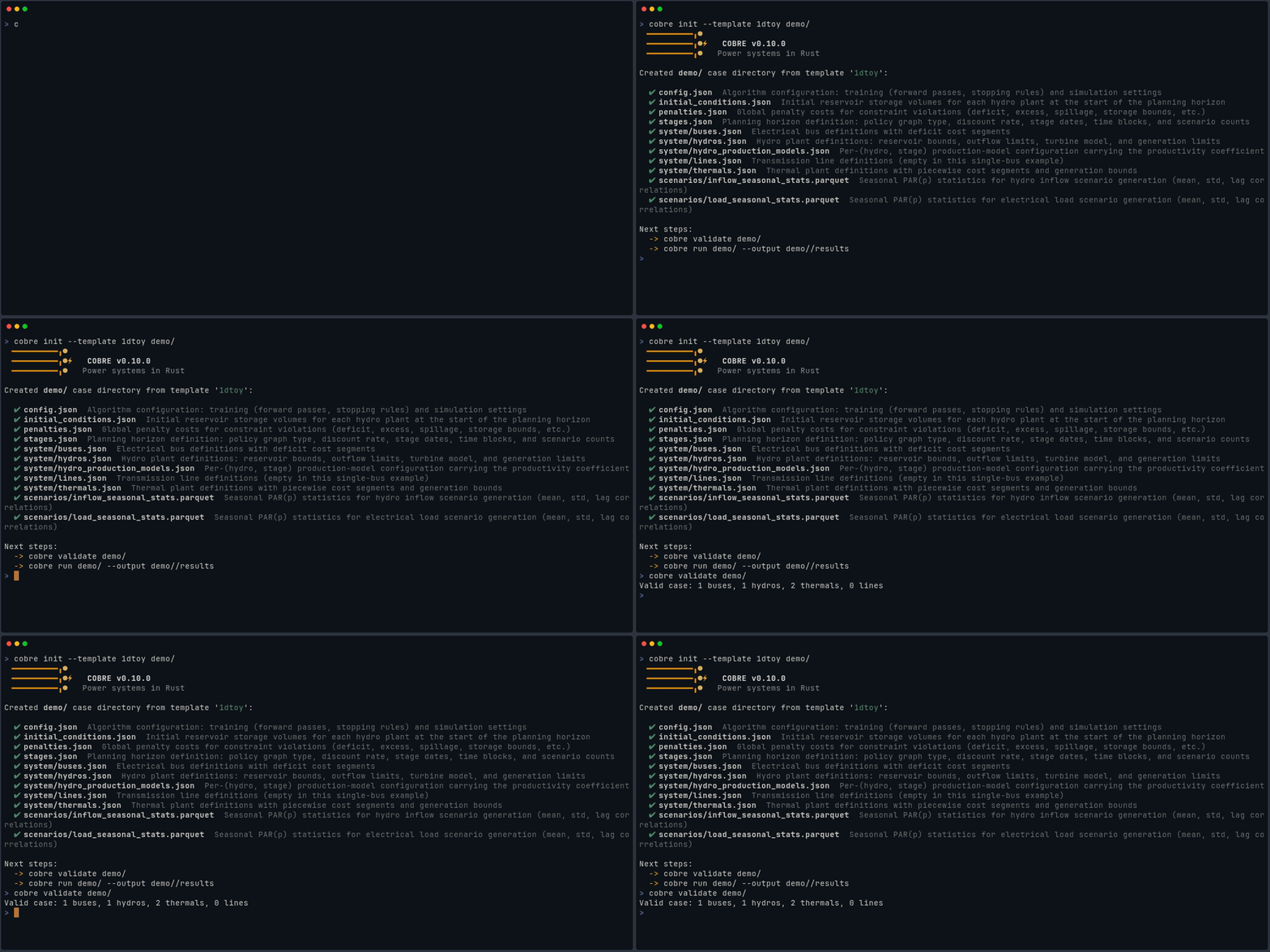
cobre validate /path/to/my_studySuccessful validation prints entity counts and exits with code 0:
When validation detects errors — such as missing required fields or constraint violations — it reports them with severity labels and exits with code 1:
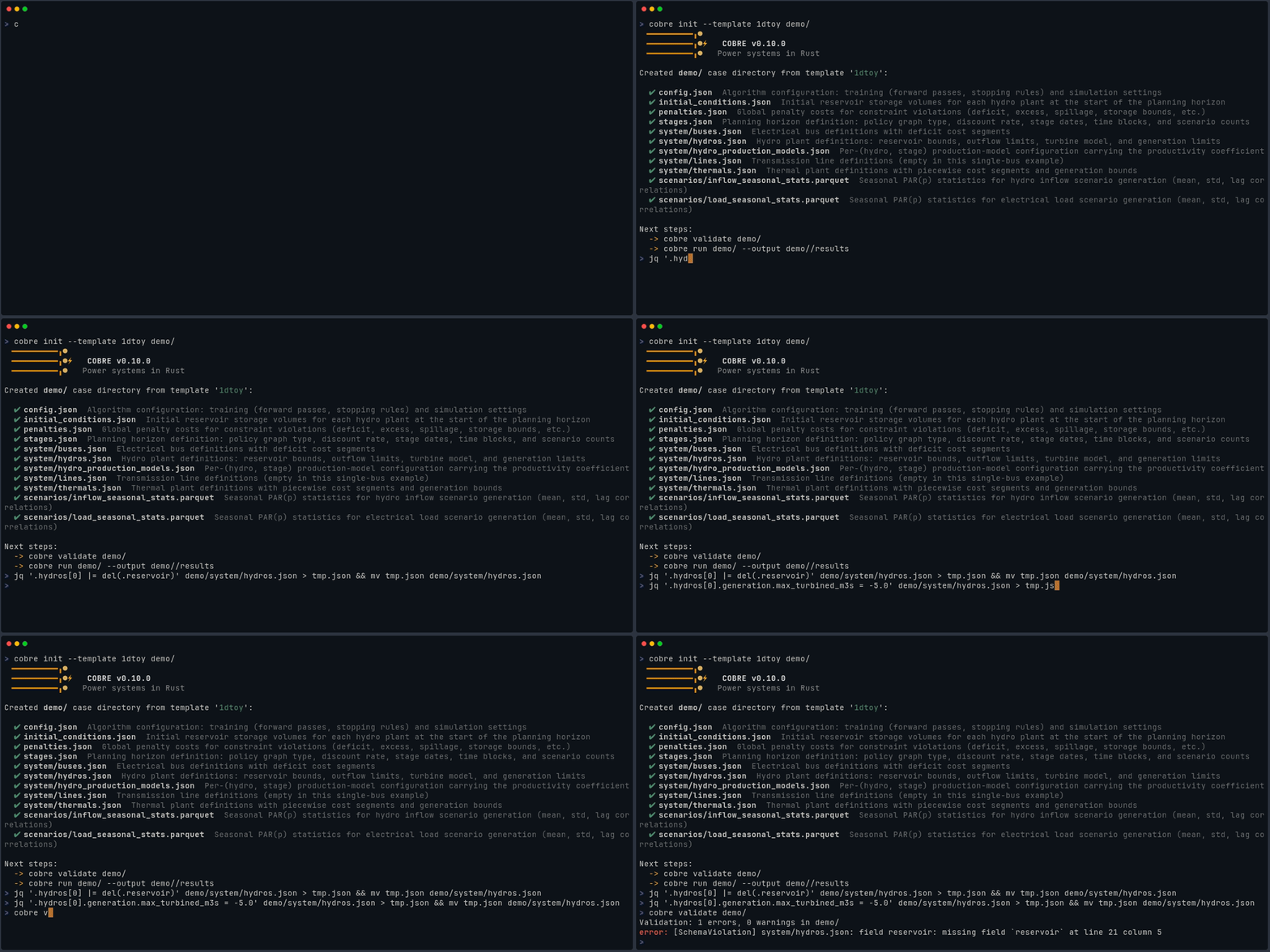
Fix any reported errors before proceeding. See Case Directory Format for the full schema.
Running cobre run
Section titled “Running cobre run”cobre run /path/to/my_studyBy default, results are written to <CASE_DIR>/output/. To specify a different
location:
cobre run /path/to/my_study --output /path/to/resultsLifecycle Stages
Section titled “Lifecycle Stages”- Load — reads input files, runs layered validation (exits code 1 on validation failure, 2 on I/O error)
- Train — builds the SDDP policy by iterating forward/backward passes; stops when stopping rules are met
- Simulate — (optional) evaluates the policy over independent scenarios; requires
simulation.enabled = true - Write — writes Hive-partitioned Parquet (tabular), JSON manifests/metadata, and FlatBuffers output
Terminal Output
Section titled “Terminal Output”Banner
Section titled “Banner”When stderr is a terminal, a banner shows the version and solver backend.
Use --quiet to suppress the banner, progress bars, and post-run summary.
Errors are always written to stderr regardless of --quiet.
Progress Bars
Section titled “Progress Bars”During training, a progress bar shows current iteration count. In --quiet mode,
no progress bars are printed. Errors are always written to stderr.
Summary
Section titled “Summary”After all stages complete, a run summary is printed to stderr with:
- Training: iteration count, convergence status, bounds, gap, cuts, solves, time
- Simulation (when enabled): scenarios requested, completed, failed
- Output directory: absolute path to results
Checking Results
Section titled “Checking Results”Use cobre report to inspect the results:
cobre report /path/to/my_study/outputReads manifest files and prints JSON to stdout (suitable for piping to jq):
cobre report /path/to/my_study/output | jq '.training.convergence.final_gap_percent'Exits with code 0 on success or 2 if the results directory does not exist.
Common Workflows
Section titled “Common Workflows”Training Only
Section titled “Training Only”To run training without simulation, set simulation.enabled to false in
config.json:
{ "simulation": { "enabled": false } }Simulation Against a Saved Policy
Section titled “Simulation Against a Saved Policy”To evaluate a previously trained policy without re-training:
{ "training": { "enabled": false }, "policy": { "mode": "warm_start", "path": "./policy" }}Cobre loads the policy cuts, skips training entirely, and runs simulation. See Policy Management for details on warm-start and resume modes.
Multi-threading
Section titled “Multi-threading”Use --threads to accelerate training and simulation with intra-rank
parallelism:
cobre run /path/to/my_study --threads 4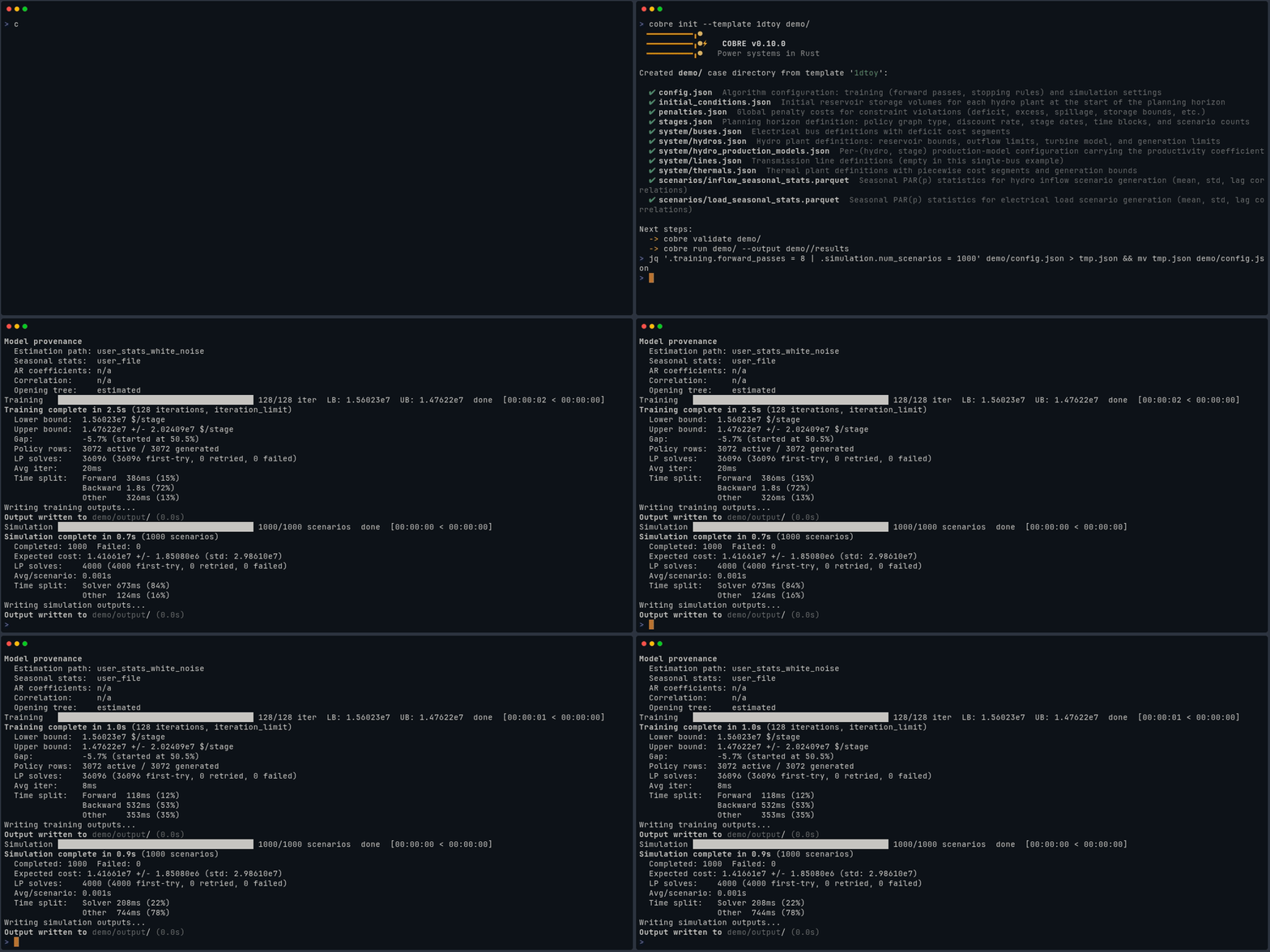
The thread pool is used for forward-pass batching and simulation scenario evaluation. Speedup depends on the number of forward passes and simulation scenarios configured.
Communication Backend
Section titled “Communication Backend”A single cobre run uses the local (single-process) backend; launching under an
MPI launcher (mpiexec, mpirun, or srun) distributes the work across ranks.
By default (--comm-backend auto) cobre detects the launcher and selects the
backend accordingly, so no flag is needed in either case. Pass
--comm-backend mpi to force the MPI backend — it fails with a clear message on a
binary built without MPI support — or --comm-backend local to force a single
process even under a launcher.
Quiet Mode for Scripts
Section titled “Quiet Mode for Scripts”cobre run /path/to/my_study --quietexit_code=$?if [ $exit_code -ne 0 ]; then echo "Study failed with exit code $exit_code" >&2fiSuppresses banner and progress output, suitable for batch scripts.
Checking Exit Codes
Section titled “Checking Exit Codes”| Exit Code | Meaning | Action |
|---|---|---|
0 | Success | Results are available in the output directory |
1 | Validation error | Fix the input data and re-run cobre validate |
2 | I/O error | Check file paths and permissions |
3 | Solver error | Check constraint bounds in the case data |
4 | Internal error | Check environment; report at the issue tracker |
See CLI Reference for the full exit code table.
Exporting Stochastic Artifacts
Section titled “Exporting Stochastic Artifacts”Set exports.stochastic to true in config.json to write the stochastic
preprocessing artifacts to output/stochastic/ before training begins:
{ "exports": { "stochastic": true }}What is exported
Section titled “What is exported”| File | Written when |
|---|---|
output/stochastic/inflow_seasonal_stats.parquet | Estimation was performed |
output/stochastic/inflow_ar_coefficients.parquet | Estimation was performed |
output/stochastic/correlation.json | Always |
output/stochastic/fitting_report.json | Estimation was performed |
output/stochastic/noise_openings.parquet | Always |
output/stochastic/load_seasonal_stats.parquet | Load buses exist |
“Estimation was performed” means the user did not supply the corresponding
scenario file; Cobre derived it from inflow_history.parquet.
Round-trip workflow
Section titled “Round-trip workflow”Because every exported file uses the exact same schema as the corresponding
input file, you can copy the exported artifacts back to scenarios/ and
re-run to reproduce the identical stochastic context without re-running
estimation:
# Step 1: initial run with stochastic export enabled in config.jsoncobre run my_case
# Step 2: copy artifacts to scenarios/cp -r my_case/output/stochastic/* my_case/scenarios/
# Step 3: re-run — estimation is skipped, opening tree is loaded directlycobre run my_case
The re-run is faster (no Levinson-Durbin fitting or spectral decomposition) and produces bit-for-bit identical stochastic artifacts.
For the complete schema of each exported file, see Stochastic Artifacts in the Output Format Reference.
See Also
Section titled “See Also”- Theory: SDDP Algorithm — the forward/backward pass algorithm this workflow trains and runs.